
Interoperability between Health Information Systems
Learn how health information systems integrate
Introductory | 50h | Live Online | 240 USD



 85 students have taken this course
Includes
4 sessions
Presentations
4 optional assignments
Certificate of participation/completion
Skills covered by this course
Interoperability HL7 v2.x DICOM openEHR
Course description
"Interoperability" is the ability of two or more systems to exchange information (syntactic) and for that information to be correctly understood (semantic). For our systems to have this ability, it is necessary to work on the integration of dispersed and distributed data and systems. In this course we will learn how to work with different standards for the definition and exchange of information that will allow us to integrate data and systems to achieve the ability to interoperate.
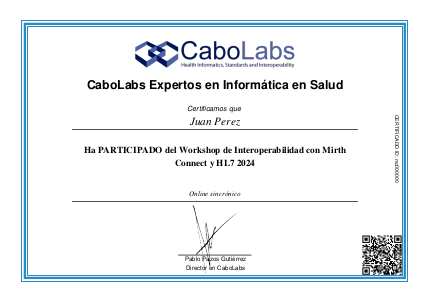
Certificate
The certificate includes a QR code for sharing.
Instructor

Pablo Pazos
Integration EngineerProgram
Objective
The central objective of the course is to know and test different standards from a practical point of view, focusing on interoperability between hospital information systems.
At the end of the course, students will have hands-on experience with different communication protocols, message formats and tools that facilitate the implementation and testing of communications.
Why is it needed?
Health information systems are frequently designed and implemented as isolated silos. These systems have major limitations when it comes to assisting clinical decisions, enabling better quality of patient care, better clinical management, and defining health policies aligned with each country's reality. The reason for all these problems is that systems are basically large clinical data repositories that lack any capacity for effective use of that information. Interoperability, understood as the capacity to share information between systems—and for that information to be interpreted and used effectively—allows overcoming the problems of monolithic, isolated systems that do not comply with standards.
Standards are necessary for interoperability, and among them we have different levels: technical standards such as communication protocols (TCP, MLLP, HTTP, SOAP, DICOM), information standards (openEHR), formats and messaging (HL7 v2.x, XML, JSON, DICOM, openEHR) and semantic standards (openEHR Archetypes and Templates). In this course we will see all levels of standards, with a practical orientation.
Who is it for?
The main audience for this course is IT professionals and students (software architects, programmers, technical leads, network managers, among others). Knowledge of communication protocols (TCP, HTTP) and formats such as XML and JSON is recommended. Programming knowledge is required. Java will be the reference language in the course, but you may use other languages in the practices.
Certification
PARTICIPATION certificates will be issued to all students enrolled in the course.
COMPLETION certificates will be issued to those who complete practical tasks and have an evaluation score above 6/10.
Modules
HIS Architecture and Communication Protocols
- Hospital information system architecture
- Communication protocols and messaging formats
- Tools for working with inter-system communication
HL7 v2.x Messaging
- HL7 v2.x messaging, structure and domains
- ADT, ORM, ORU and ACK message types
- Creating messages with HAPI, using ER7 and XML encodings
- HL7 use case examples
PACS Systems and DICOM Communication
- Radiology system architecture (RIS, PACS, Modalities, Viewers)
- DICOM information model and DICOM tags
- DICOM services and WADO
- Tool presentation: DCM4CHEE and DCM4CHE Toolkit
Interoperability with openEHR
- Clinical record structure with openEHR (Information Model, Archetypes and Templates)
- openEHR clinical document management (generation, processing, validation and versioning)
- Clinical document storage and queries
Related courses
Do you have any questions?
Let us know how we can help you.