
Clinical Information Modeling with openEHR Archetypes and Templates
openEHR is the open standard for future-proof electronic health records
Introductory | 20h | Pre-recorded | 200 USD



 23 students have taken this course
Includes
22 videos
Presentations
Clinical modeling cases
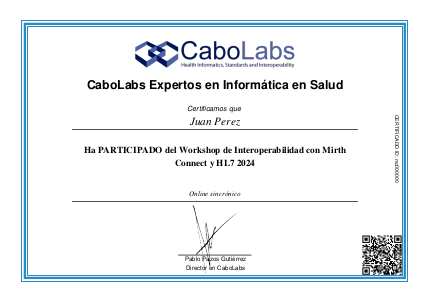
Certificate of participation
Skills covered by this course
openEHR
Course description
The openEHR Dual Modeling methodology creates the need for professionals trained in clinical information modeling, to build the elements necessary to store, manage and share clinical information between different systems and organizations in a standardized way. Even when openEHR is not used in the systems, its modeling methodology allows standardizing various aspects of the definition of the information to be managed, also allowing formal management of models and their variations over time.
Certificate
The certificate includes a QR code for sharing.
Instructor

Pablo Pazos
Integration EngineerProgram
Objective
The objective of this course is for students to know and gain experience in clinical information modeling using openEHR archetypes and templates, with a focus on a formal methodology and using freely available tools.
We will see how to analyze requirements with mind maps and object-oriented models (UML), modeling clinical content with openEHR archetypes, and creating complete clinical document models with openEHR templates. Achieving detailed documentation of models, standardization of clinical document structures, and the ability to use these models in software and simplify future change management.
Why is it needed?
All health information system projects require analysis and modeling of data structures for clinical records. It is common for this process to be informal, without a clear methodology, without using standards or best practices, resulting in low quality models that may be incomplete and incorrect, negatively affecting the quality of the systems that implement these models (low maintainability, information processability, flexibility and interoperability).
The Clinical Information Modeling Course proposes a novel approach to face the current challenges in health informatics projects and achieve better quality models and systems, accompanied by better management of clinical knowledge and evolution of clinical records in the future.
Who is it for?
This course is of interest to all professionals and students, both from clinical areas (doctors, nurses, technicians) and IT (engineers, programmers, database administrators, systems analysts, etc.).
Certification
PARTICIPATION certificates will be issued to all students enrolled in the course.
COMPLETION certificates will be issued to those who complete practical tasks and have an evaluation score above 6/10.
Modules
Introduction
- Motivation
- Role of the clinical information modeler
- Modeling techniques and tools
- Introduction to the openEHR information model
Archetypes and tools
- Practice presentation
- Archetype modeling process
- Concept classification
- Detailed data analysis
- Introduction to the Clinical Knowledge Manager
- Introduction to ADL
- Introduction to the Archetype Editor
Archetype modeling activities
- Creating archetypes for different entry types
- Creating archetypes for documents
Archetype management and template modeling
- Archetype life cycle
- Archetype modification
- Technical validation of archetypes
- Template modeling process
- Introduction to the Template Designer
- Clinical document modeling practices
- Using templates in software applications
Recommended prerequisite courses
Related courses
Do you have any questions?
Let us know how we can help you.