
Health Information Systems Implementation with openEHR
openEHR is the open standard for future-proof electronic health records
Introductory - Intermediate | 15h | Live Online | 240 USD



 16 students have taken this course
Includes
4 sessions
Presentations
Optional assignments
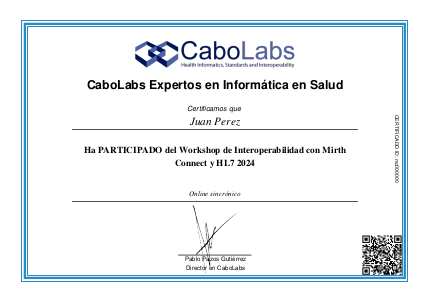
Certificate of participation/completion
Skills covered by this workshop
openEHR Interoperability
Course description
openEHR is a set of specifications for the components of clinical information platforms, including multiple desirable characteristics: vendor neutrality, technology independence, maintainability, standardized and versioned data, semantically coherent. In this course you will learn to work with openEHR across the four software layers: persistence, logic, user interface and service interface.
Certificate
The certificate includes a QR code for sharing.

Instructor

Pablo Pazos
Integration EngineerProgram
Objective
The Health Information Systems Implementation with openEHR course aims to provide the knowledge necessary to implement software components based on the openEHR standard specifications, including: user interface generation, clinical data validation, generation of clinical documents in JSON and XML, clinical database design, and communication of clinical data between systems.
Why is it needed?
The openEHR standard allows improving multiple aspects of health information systems, such as flexibility, maintainability, interoperability, accessibility, and technological independence. The implementation of the standard is not simple. There are multiple technical, conceptual and methodological challenges that require a large investment of time in research and development that not everyone can undertake.
This course is dedicated to those who wish to learn more about the standard and how it is applied, as well as to test technologies and learn about best practices in the design and implementation of health information systems. This will allow shortening the gap between the conceptual knowledge of openEHR and implementation in a specific technology.
This is the first openEHR implementation course worldwide.
Who is it for?
The main audience for the course is IT professionals and students (software architects, programmers, technical leads, among others), with an interest in the development of health information systems and the openEHR standard.
Knowledge of communication protocols (TCP, HTTP), formats such as XML and JSON, and basic openEHR knowledge is recommended. Programming knowledge is required. Java and Groovy will be the reference programming languages in the course, but you may use other languages in the practices.
Certification
PARTICIPATION certificates will be issued to all students enrolled in the workshop.
COMPLETION certificates will be issued to those who complete practical tasks and have an evaluation score above 6/10.
Modules
Introduction
- openEHR overview
- Reference architecture
- Archetypes and templates
- Modeling activity
- Archetypes and templates in software activity
Clinical information repositories with openEHR
- Introduction to clinical information repositories
- openEHR repositories
- Database technology comparison
- Object-Relational Mapping
- Design and query activities
- Introduction to AQL
- Storage, query and retrieval services
User interfaces for clinical applications
- Introduction to user interfaces
- User interfaces with openEHR
- UI Templates model
- Automatic generation of user interfaces (forms)
- Form generation activity
Exchange formats and REST API
- openEHR XML and JSON formats
- Data generation activity
- Serialization, validation, parsing and transformation activity
- Introduction to HTTP
- openEHR REST API specification
- REST API activity in Atomik
- Data querying
Related courses
Do you have any questions?
Let us know how we can help you.