
openEHR Fundamentals and Implementation
openEHR is the open standard for future-proof electronic health records
Introductory | 25h | Live Online | 200 USD



 196 students have taken this course
Includes
6 sessions
Presentations
2 optional assignments
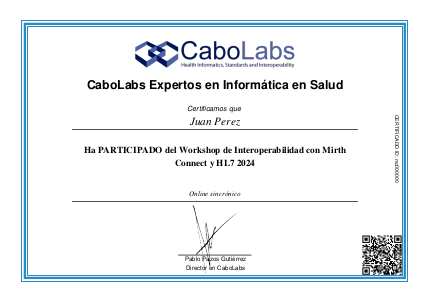
Certificate of participation/completion
Skills covered by this course
openEHR
Course description
The openEHR standard is focused on defining and managing clinical information over the long term, maintaining structural and semantic consistency across all the information in a patient's Electronic Health Record throughout their life. In this course we will explore the openEHR specifications to understand what they involve and how we can apply them in our own systems.
Certificate
The certificate includes a QR code for sharing.

Instructor

Pablo Pazos
Integration EngineerProgram
Objective
The main objective of the course is for students to know the openEHR standard in detail, its role in health informatization projects, its scope, complementarity with other standards, how it contributes to improving the quality of health information systems, its contribution to interoperability, and to learn to use the tools and methodologies necessary for its implementation.
Students will be instructed in the openEHR specifications, including the Clinical Information Model and the Archetype Model, and in the Modeling of Clinical Content through openEHR archetypes. Also including concepts of Health Information Systems, Interoperability, Standards and various tools.
Why is it needed?
Health information system projects are booming. Some projects have been successful and have become highly profitable products, but many others have not had the expected impact or have failed after large investments. This is due to multiple factors, including deficient or incomplete technical proposals, the high complexity of clinical information, lack of standardization of clinical information, great technological dependence created by the software industry, and the development or acquisition of inflexible systems unable to adapt to future requirements.
The openEHR standard proposes several solutions to address these problems and challenges, with a revolutionary approach that empowers health professionals, making them key actors in health information system projects. It proposes a sustainable long-term approach, focused on the management of clinical knowledge rather than technologies. openEHR allows creating quality, generic, flexible, adaptable, interoperable and long-term maintainable information systems. Furthermore, openEHR is complementary to other industry standards widely used internationally for data exchange between systems such as HL7 and DICOM, and terminology standards such as SNOMED CT, LOINC, ICD-10, etc.
openEHR is not a new standard, it is more than 24 years old and is the result of experiences from previous research and development projects with another 15 years of experience. It has already been implemented in various countries around the world and is attracting new software vendors who want to create or improve their products.
Who is it for?
This course is of interest to all professionals and advanced students from both IT and clinical areas who wish to participate in health informatization projects. It targets multiple roles as it promotes the need for multidisciplinary teams in health informatics projects. Among these roles: doctors, nurses, technologists, technicians, programmers, architects, project managers, among others.
Certification
PARTICIPATION certificates will be issued to all students enrolled in the course.
COMPLETION certificates will be issued to those who complete practical tasks and have an evaluation score above 6/10.
Modules
Basic Concepts and Introduction to openEHR
- Current approach in Health Information System design and development
- Requirements and uses of the Electronic Health Record
- Basic architecture of openEHR systems
- Two-level modeling
- Archetype and template concepts
Information Model I
- Clinical record organization
- Hierarchical levels of the openEHR Information Model
- Detail of the openEHR Information Model (I)
Information Model II
- Detail of the openEHR Information Model (II)
- Information Model examples for representing clinical information
Archetype and Template Model
- Archetype model and constraints
- Archetype Definition Language (ADL)
- Introduction to the modeling process
- Use of standard medical terminologies
Tools and modeling exercises
- Introduction to the Clinical Knowledge Manager
- Introduction to the Archetype Editor
- Introduction to the Template Designer
- Modeling exercises
Implementation concepts and practical demonstration
- openEHR implementation strategies
- Simple application example with openEHR
- Conclusion
Related courses
Do you have any questions?
Let us know how we can help you.